

Before the Grass Changes
What Sonoma's Been Growing While Everyone
Was Watching the Vines
The Pasture
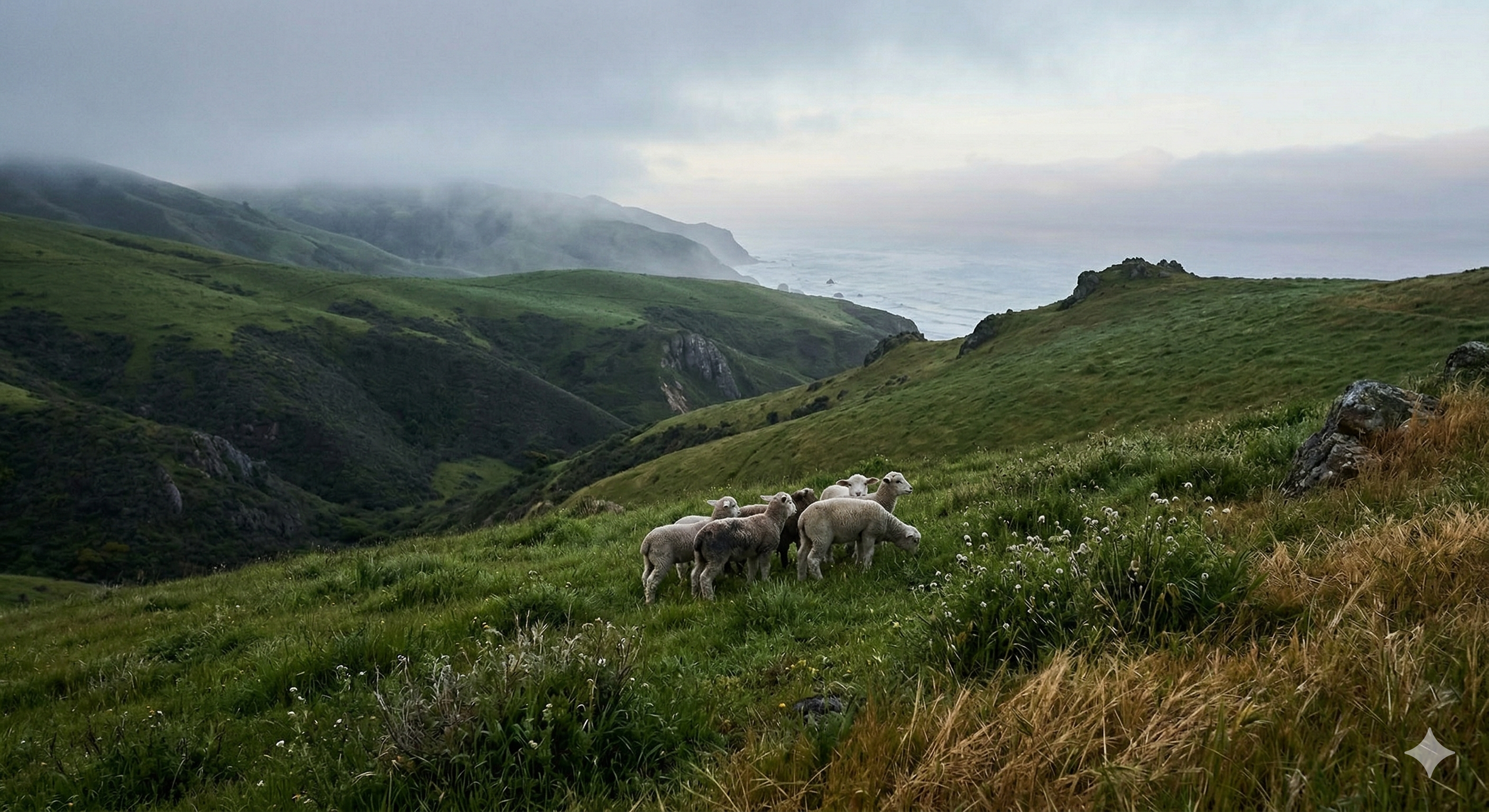
Most of the lamb on American menus traveled a long way to get there. Australia and New Zealand dominate the market, and the product is consistent, reliable, fine. But fine is not the same as remarkable, and remarkable is what happens when lamb spends its early weeks on the coastal grasslands of Sonoma County.
The pastures here — salt-kissed, cool, extraordinarily varied in what they grow — produce meat that is delicate where imported lamb can be assertive, mild where it can be gamey, genuinely sweet in a way that asks almost nothing of the cook. Colorado lamb, which holds the prestige position on most American restaurant menus, is excellent. But it is a different animal — raised on different grasses, at different altitude, with a flavor profile that reads richer and more pronounced. Sonoma spring lamb is quieter, more nuanced, more of this specific place. It is an ingredient shaped by a particular landscape at a particular moment in the year.
That moment is now. By the time summer heat changes the grass, it's gone.
The Ingredient
Spring lamb — younger, milk-fed or recently transitioned to pasture — has a quality that older lamb simply doesn't. The fat is subtle rather than waxy. The flavor is clean. There is nothing to mask or work around, which means the preparations that suit it best are the ones that step aside and let it speak.
Scottodito — small chops grilled fast over high heat with olive oil, salt and rosemary, eaten directly off the bone while they're still too hot to hold. Braised shanks, long and slow, served with a bright slaw of shaved baby fennel and citrus — cool, bright, acidic against the depth of the meat. Arrosticini, small cubes on skewers over embers, the fat rendering slowly into everything around it. Three preparations, one ingredient. The lamb is the point in all of them.
In the Glass
Sonoma has its own answer to the lamb question. For the grilled preparations — the scottodito, the arrosticini — reach for a Sonoma Coast Pinot Noir. The bright acidity and earthiness suit the delicacy of spring lamb without overwhelming it. For the braised shank, the pairing shifts: a Dry Creek Valley Grenache or a Russian River Syrah, with its peppery, savory backbone, matches the depth of a long braise and holds its own against the brightness of the fennel and citrus alongside.
The region that produced the lamb produced the wine. That is rarely a coincidence.
Where to Find It
Sonoma County has a handful of producers raising spring lamb the right way, and they are worth knowing by name. Pozzi Ranch — a fourth-generation family operation — grazes its spring lambs on Sonoma and Marin County pastures, following the growth of the grasses as the season moves. Sonoma County Meat Co. sources from Hamilton Brothers Ranch, whose flocks have grazed native California grasslands for over a century, raised without hormones and protected by livestock guardian dogs.
Beyond those names, your farmers market is the most reliable guide. The vendors who show up with spring lamb in April know exactly what they have. Ask where it was raised. The answer matters.
The Season
Sonoma's spring lamb doesn't make much noise. It appears at farmers markets and on the menus of restaurants that pay attention to what the season is actually offering, and then quietly disappears. It doesn't have the profile of the valley's Cabernet or the coast's Dungeness crab. It has never needed to.
The vines get all the attention. This month, look past them.