

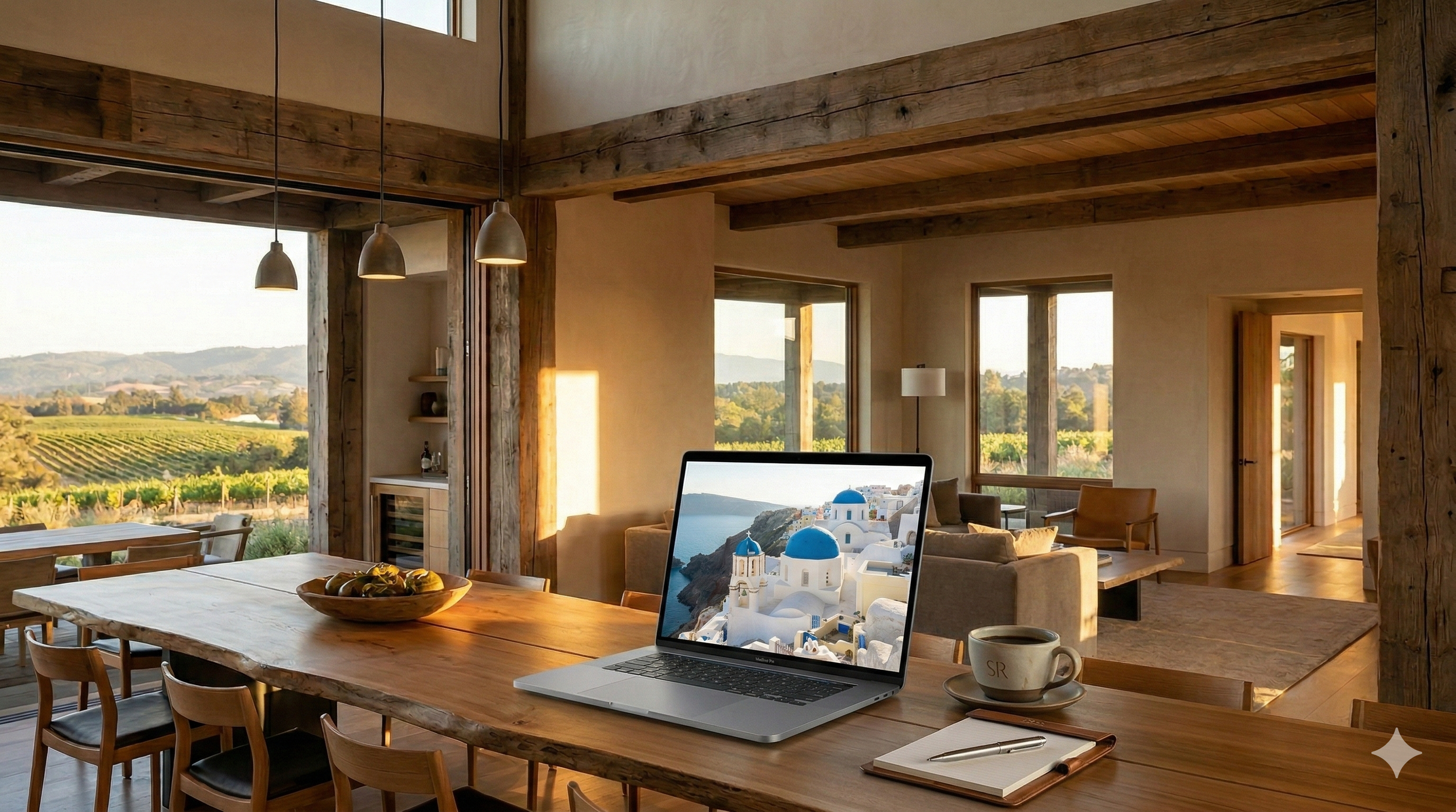
The Second Home As Passport
On ownership, experience, and the new calculus of how luxury buyers think about second homes
March 2026
The most telling shift in how sophisticated buyers approach second-home ownership isn't about location, price point, or even lifestyle category. It's about a more fundamental question: what is a second home actually for?
For most of the last two decades, the answer was relatively straightforward. A second home was a sanctuary — a fixed counterweight to a demanding primary life, valued for its consistency as much as its beauty. You knew where everything was. The rhythms were yours. The place became, over time, an extension of identity.
That model remains as compelling as ever. But it's being expanded by something the market is starting to confirm: at a certain level of wealth, the buyers most engaged with the acquisition process are increasingly asking not just what a property is, but what it enables. The question has grown from asset to activation.
Ownership as a Platform
The second home has always been more than a financial asset — it's a platform for a particular kind of life. Weekends that restore. Gatherings that matter. A place your family orients around for decades. The most sophisticated buyers have always understood this, which is why the decision to acquire rarely comes down to yield calculations alone.
What's newer is the idea that the platform can extend beyond the property itself. That the same ownership — the same deed, the same home you love — can also be the credential that unlocks experiences well beyond its four walls. The weeks you're not there, rather than simply carrying cost, become something more interesting.
One Answer Worth Knowing About
ThirdHome is a private exchange club — founded in 2010, now with over 30,000 properties across 100 countries — built on exactly this premise. The model: members make their second home available to other vetted members for a defined number of weeks per year, earning travel credits in return. Those credits can be used to stay in other members' properties worldwide, on an independent schedule, with no requirement for a simultaneous swap.
The economics are straightforward. Exchange fees typically run well under $1,000 for the week. Members routinely access properties — châteaux in Burgundy, estates in Patagonia, penthouses in cities they'd otherwise pay $10,000 a week to rent — at a fraction of market rate. The math works because the platform runs on reciprocity rather than commerce.
But the more significant thing ThirdHome offers isn't savings. It's a reframe. The weeks a second home sits empty — and every second home has them — stop being carrying cost and start being currency. Unused time becomes the mechanism for a travel life that ownership alone couldn't fund.
A few things worth understanding before exploring membership: entry requires application and review, with properties evaluated on location, quality, and appointments. The model rewards members who travel frequently more than occasional ones — value scales with participation. And like any club, it's worth understanding the structure before assuming it fits your patterns of use.
What It Reveals
ThirdHome represents a broader pattern we're watching in the high-net-worth market: the move from ownership as accumulation toward ownership as infrastructure for experience. The property is still the anchor. But the anchor is now expected to do more.
This thinking connects directly to what we've observed in the growth of branded residences — buyers willing to pay a significant premium for the operational layer that eliminates friction and restores time. ThirdHome operates on a different price point and a different mechanism, but the underlying logic is the same. Sophisticated buyers are asking what each dollar of real estate capital activates, not just what it stores.
For buyers considering Wine Country, this has a practical implication. A Healdsburg estate or a Napa Valley property in the right location and condition isn't just a home. It's a qualifying asset — one that could, with the right membership structure around it, anchor a significantly larger travel life. That's not a reason to buy. But it is a dimension of the ownership decision that's worth understanding before you do.
The question worth sitting with: are you buying a destination, or are you buying a key?
A Note from SagePoint
ThirdHome is one of several membership structures worth understanding before — not after — a second home purchase. We've followed the platform closely enough to speak to how membership works, whether a property qualifies, and how it fits into a broader ownership strategy. If you're exploring a Wine Country acquisition and want to understand how ThirdHome factors into that decision, it's a conversation worth having.