

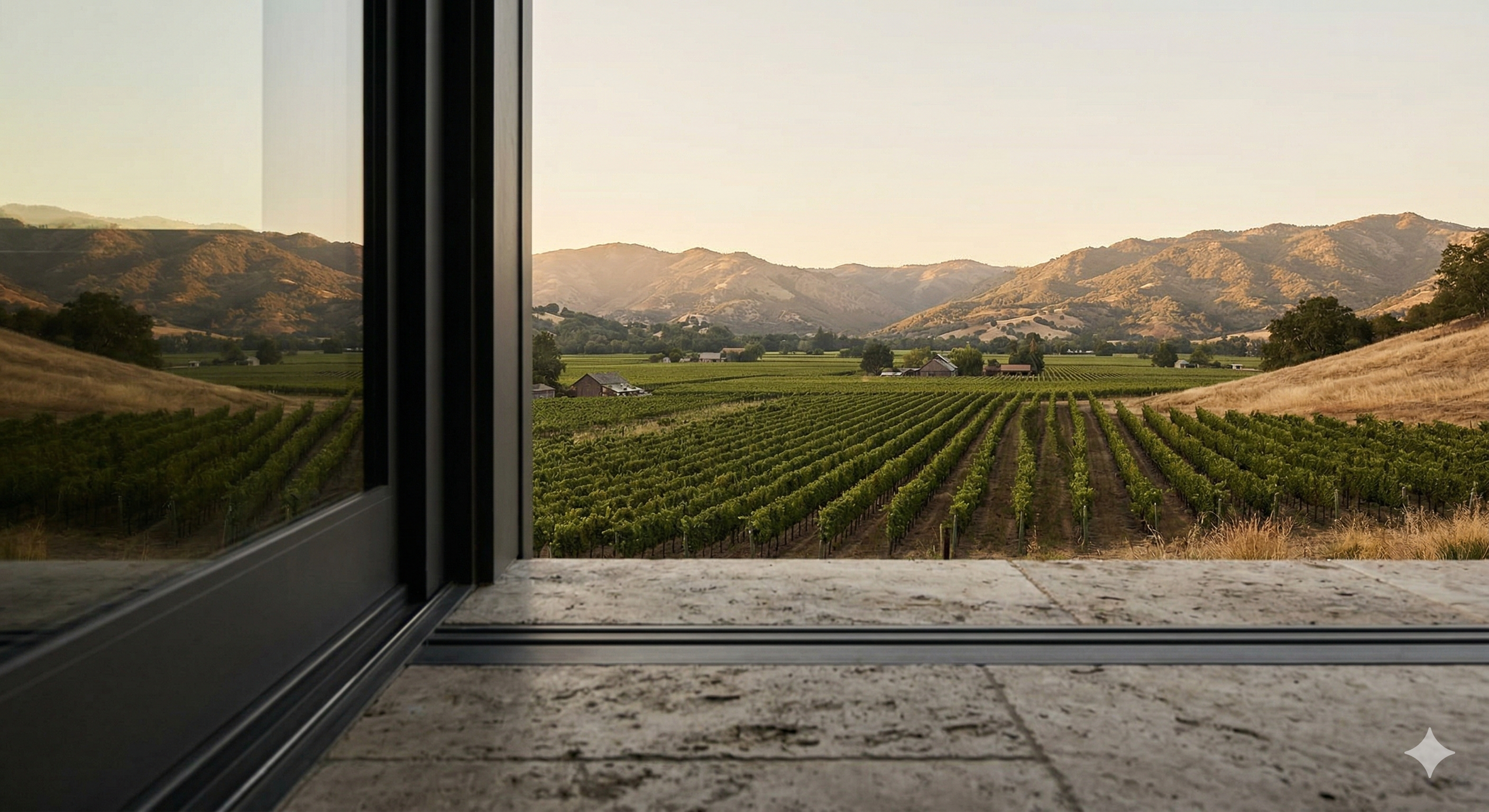
The Preserve Principle
Two Kinds of Scarcity and Why Only One of Them Matters
April 2026
A Line Drawn in 1968
In 1968, Napa County did something that most regions never had the foresight or political will to attempt. Facing development pressure that was already reshaping the Bay Area, the county drew a line around its valley floor and protected it — permanently — from residential subdivision. The Napa Agricultural Preserve, the first of its kind in the United States, placed tens of thousands of acres under agricultural protection. Sonoma followed its own path to similar ends through urban growth boundaries and agricultural zoning that have held, with very few exceptions, for decades.
No one drawing that line in 1968 was thinking about Michelin stars, or Four Seasons residences, or $8 million private homes anchored by hospitality brands. They were protecting farmland. What they also created, without quite meaning to, was one of the most structurally constrained luxury residential markets in the American West. The supply of entitled residential land in Wine Country is not a function of developer appetite, interest rate cycles, or industry performance. It is a function of geography and policy that predate the current market by half a century.
Cyclical Scarcity
Most buyers are trained to watch one kind of scarcity: the kind that appears in market reports. Inventory levels. Days on market. Transaction volume. This is cyclical scarcity — real, meaningful, and worth tracking — but it responds to conditions. Interest rates shift. Sellers re-enter. New product comes online. What feels scarce in one quarter can look different in the next.
The current moment has introduced a particular version of this. The wine industry's ongoing correction — well-documented, widely discussed — has brought a certain volume of distressed agricultural property and operationally complex vineyard estates into the conversation. Downtown Napa and Healdsburg are seeing new residential density, condominiums rising within urban cores as development pressure finds the only release valve the policy left open. To a casual observer, this reads as supply expanding.
It is worth understanding exactly what kind of supply it is.
Structural Scarcity
There is a second kind of scarcity that market reports don't measure, because it doesn't move. It is built into the land itself — into the decisions made in 1968, and the zoning ordinances and growth boundaries that followed. You cannot subdivide the protected valley floor. The downtown density projects in Napa and Healdsburg are not contradictions of this scarcity — they are evidence of it. Growth is finding the urban core because the agricultural land remains closed.
What this means for the serious buyer is straightforward: the distressed vineyard estates appearing in headlines are operating businesses caught in an industry-wide demand reset. They are not the residential inventory that belongs to the luxury tier. Branded residential offerings in Wine Country — Four Seasons, Montage, Auberge, Rosewood — are each conceived as intimate, finite collections. Taken together, the total inventory across all of them could be counted in the dozens. That is not a market condition. That is a structural feature of the place.
This is structural scarcity. It does not respond to what the wine industry does this year, or next. It was settled law before most of its current beneficiaries were born.
What the Current Moment Reveals
Markets go through periods that generate noise — distressed assets, industry corrections, headlines that conflate adjacent categories. These moments can create a momentary impression of softness that the underlying market doesn't actually reflect. They can also, for the buyer paying attention to the right things, create unusual clarity.
When cyclical scarcity is elevated and structural scarcity is unchanged, the distance between them becomes visible. The correction isn't threatening the luxury residential tier in Wine Country. It is illuminating it — separating what is permanently finite from what was always contingent.
The AG Preserve hasn't moved. The hospitality brands that have staked their reputations on this region — Four Seasons, Montage, Auberge, Rosewood — did so precisely because the place has permanence. The landscape that drew buyers here decades before the current market existed remains exactly as protected as it was in 1968. What changes, periodically, is how clearly you can see it.
The Buyer Who Understands the Difference
There is a category of buyer for whom the current moment is not confusing. They are not reading wine industry headlines and wondering what that means for their property search. They understand that cyclical conditions create urgency, but structural conditions create value — and that the most considered acquisitions tend to happen in the space between noise and clarity.
Wine Country has always rewarded that buyer. The Preserve Principle hasn't changed. It just occasionally needs a moment like this one to come back into focus.