

No Windshield Required:
Redefining the Valley One Mile at a Time
Napa's 47-Mile Trail Is Almost Complete — And It's Changing Everything
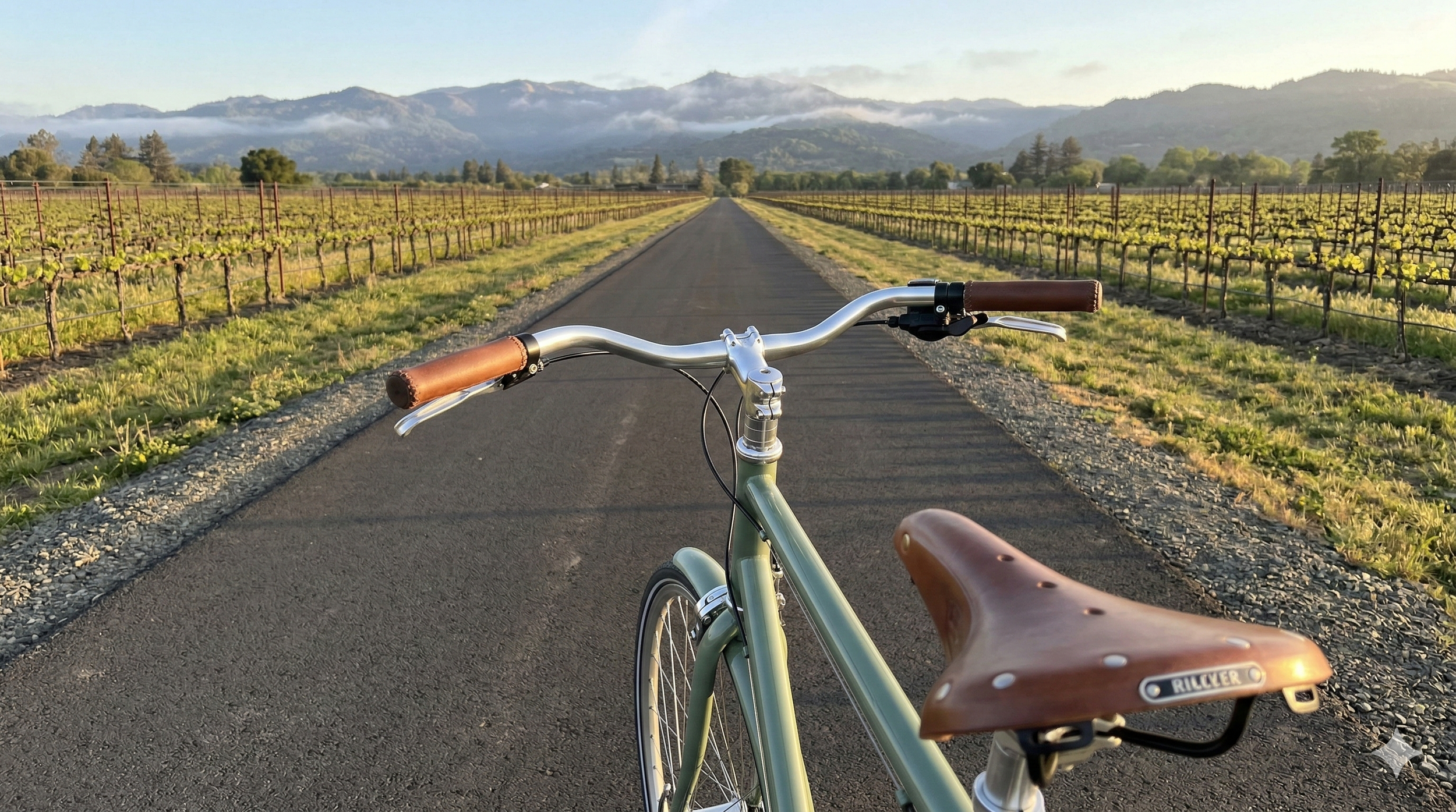
There's a moment on the Napa Valley Vine Trail, somewhere between the Oak Knoll vineyards and the edge of Yountville, when the highway noise drops away and you realize you're moving through one of the most extraordinary agricultural landscapes on earth with nothing between you and it. No windshield. No parking structure. Just vines, and light, and the Mayacamas in the distance.
That moment — replicated 500,000 times a year — is the product of a 15-year grassroots effort to do something genuinely unusual: build a world-class car-free corridor through a world-class wine valley. And as of early 2026, it's closer to completion than most people realize.
What It Is
The Napa Valley Vine Trail is a 47-mile paved, protected walking and biking path connecting the Vallejo Ferry Terminal in the south to Calistoga in the north, threading through every significant appellation along the way. It follows the old Southern Pacific rail line and the Highway 29 corridor, linking five cities, one town, and two counties in a single unbroken ribbon through the valley.
Approximately 27 miles are complete as of this spring — running continuously from Vallejo through the City of Napa to Yountville on the south end, and a separate 8.2-mile segment connecting St. Helena to Calistoga in the north. The final piece — a 10-mile stretch through the heart of Rutherford and Oakville, closing the gap between Yountville and St. Helena — is the last significant construction project, with completion projected by 2028.
When it's finished, you will be able to bike from a Bay Area ferry to a Calistoga café without once sharing a lane with a car.
The Numbers Tell the Real Story
What elevates the Vine Trail beyond recreational amenity is the nature of its ridership. Of the 500,000 annual users, 70% are local residents — not tourists. That ratio is the point. This isn't a visitor attraction that locals tolerate; it's active infrastructure woven into the fabric of daily Napa Valley life. Residents use it to commute, run errands, connect with friends, and simply move through a valley that has always been more beautiful than its traffic suggested.
The project's ambition matches its complexity — 32 public and private organizations collaborating on a $60 million effort that began with a vintner's question: why doesn't Napa Valley have what great wine regions around the world have — a way to move through them that feels commensurate with their beauty?
Fifteen years later, the Great Wine Capitals Global Network has recognized the Vine Trail with a 2024 Best of Wine Tourism Award, placing it alongside trail infrastructure in Bordeaux, Cape Town, and Mendoza. Tourists who incorporate the trail into their visit stay an average of two nights longer. The trail, it turns out, changes people's relationship to the valley — slowing it down, making it intimate, making it feel like somewhere to live rather than somewhere to pass through.
A New Kind of Investment in the Corridor
The trail's growing completeness is already reshaping how developers think about the valley. The Elene — a 50-room boutique resort by Mosaic Hotel Collection, the team behind North Block Hotel in Yountville and The Madrona in Healdsburg — is under construction on a 5-acre site in north Napa explicitly anchored to the trail. Opening late summer 2026, it's built around a bike barn, guided cycling program, and a café designed as a community gathering point for riders. The entire concept assumes the trail as infrastructure, not amenity.
That a hospitality operator of Mosaic's caliber chose to design around the trail rather than simply near it is a quiet signal about where value is accumulating in the valley.
The Bigger Picture
The Vine Trail began as an idea about beauty — about moving through Napa at a pace slow enough to actually see it. What it's becoming is something more fundamental: a 47-mile spine of connected, human-scale infrastructure that runs the entire length of the valley and quietly redefines what it means to live here.
By 2028, when the final gap closes and the path is continuous from tidewater to the foot of Mount St. Helena, Napa Valley will have something no amount of hotel development or restaurant openings can manufacture. Not a destination. A place.
The trail doesn't just pass through the valley. Increasingly, it defines it.
Explore the route and current conditions at vinetrail.org