

Art in Plain Sight
Walk or bike the two miles of the Vine Trail through downtown Napa and you pass through a museum without quite noticing. Along the old rail corridor, murals rise several stories on the backs of ordinary buildings, a 700-foot wave of Op Art here, a moody figure reaching for a glowing butterfly there, work by internationally recognized artists set against loading docks and signal boxes. This is the Rail Arts District, a free, open-air gallery that has been growing along the tracks since 2017. Most people moving through it are on their way somewhere else, and the murals blur past like scenery.
Once you start noticing, it turns up everywhere. A few blocks over, the Napa Art Walk sets juried sculpture along downtown sidewalks, rotating every couple of years, each piece quietly for sale. None of it asks for your attention the way a museum does. It simply lives among the storefronts and the foot traffic, part of the texture of an ordinary afternoon.
That texture runs deeper than most visitors, and plenty of residents, realize. What downtown offers in the open, the valley's estates hold at a level that would anchor a serious museum anywhere. Up on Mount Veeder, Hess Persson Estates keeps a collection that ARTnews has ranked among the top 200 private holdings in the world, Francis Bacon and Robert Rauschenberg and Anselm Kiefer among them, and an Andy Goldsworthy piece built from chestnut stalks bound with nothing but hawthorn thorns. The gallery is free to walk through. From the road, it looks like just another winery.
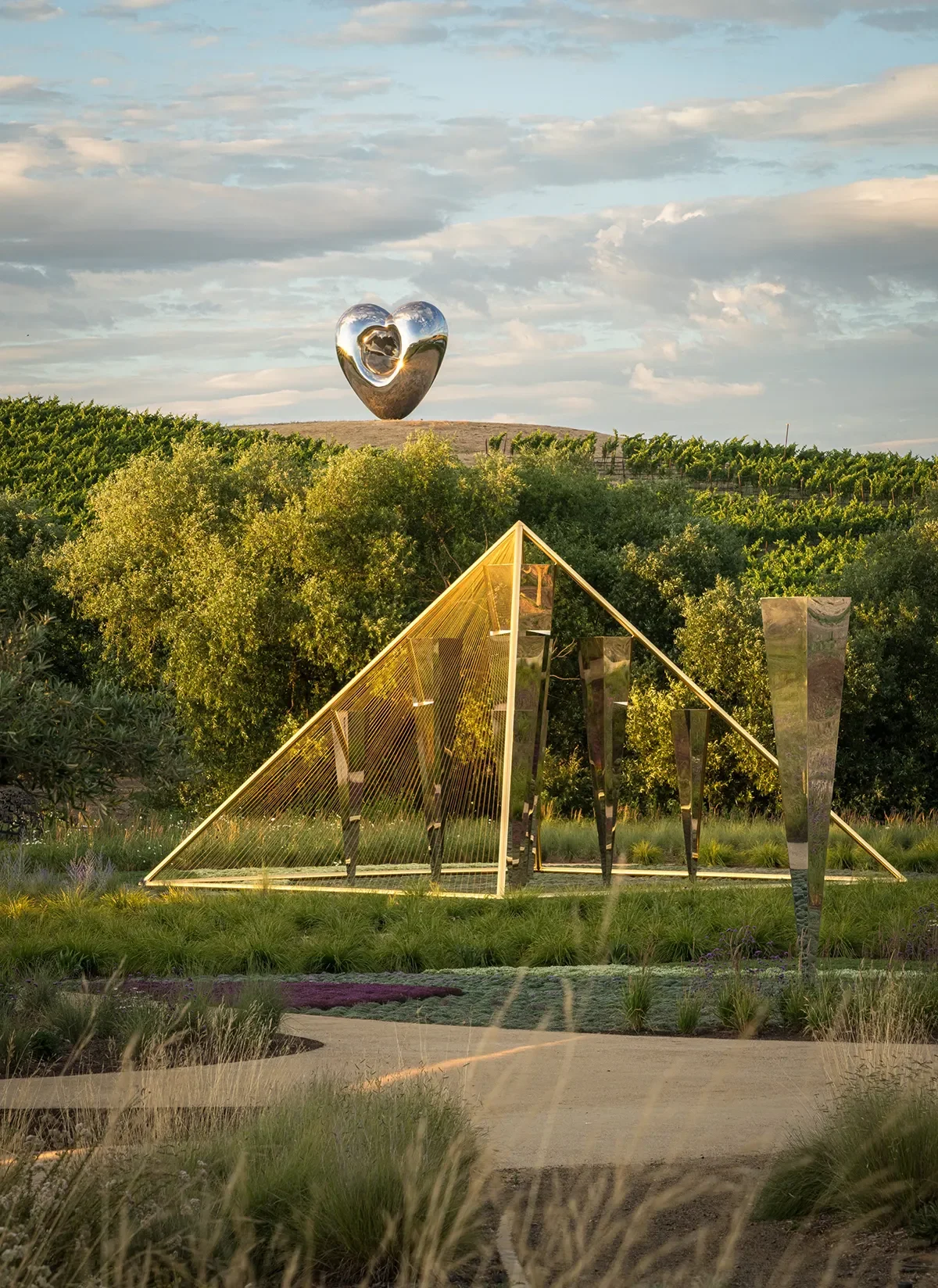
In Sonoma, The Donum Estate scatters more than fifty monumental sculptures directly across its working vineyards, a towering Ai Weiwei, a Louise Bourgeois spider, Robert Indiana's LOVE, all of it weathering in the open air among the pinot noir. There is something clarifying about coming upon a masterwork framed by vines rather than a white wall, art and agriculture sharing the same ground. Down in Rutherford, the sculpture garden at Auberge du Soleil winds through heritage olive trees, more than a hundred works tucked among the branches, and here is a detail that says everything about how this valley treats its art: every piece is for sale, and they change hands so quickly that the resort long ago stopped printing a map, because it kept going out of date. And in Yountville, Cliff Lede runs a lifelong love of rock and roll straight through the winery, a lounge hung with music-world art and vineyard blocks named after favorite songs, proof that a serious collection need not be a solemn one.
Some of this art hides because it is genuinely hard to reach, behind a reservation, a gate, a guest list. And some of it hides in plain sight, free and public and passed a thousand times without a glance. Both disappear for the same reason: in a place this saturated with beautiful things, the extraordinary starts to read as ordinary.
No place embodies that more poignantly than the di Rosa, the Carneros art center holding some two thousand works of Northern California art, which spent years watching people drive past on the highway without any idea what was there. That may be about to change. Di Rosa is moving toward opening much more of its land to the public, with plans that would carry visitors up toward Milliken Peak and its long views of the valley and the bay, sculpture dotting the trail along the way. It is a fitting turn for a place its founder always imagined as an art and nature preserve, art meant to live in the Northern California landscape rather than be shut away from it.
For anyone who wants to meet the makers themselves, September offers an open door. On the last two weekends of the month, Napa Valley Open Studios opens dozens of local artists' working spaces to anyone curious enough to step inside.
It is easy to think of this valley as devoted to a single pleasure. It is really devoted to craft in all its forms, the patient, exacting work of making something and getting it right, whether that something is a cabernet, a mural along the tracks, or a sculpture left to weather among the vines. The art has been here all along, downtown and up the mountain roads, in plain sight and just out of it. The only thing required to enjoy it is the habit of looking a little more closely.